

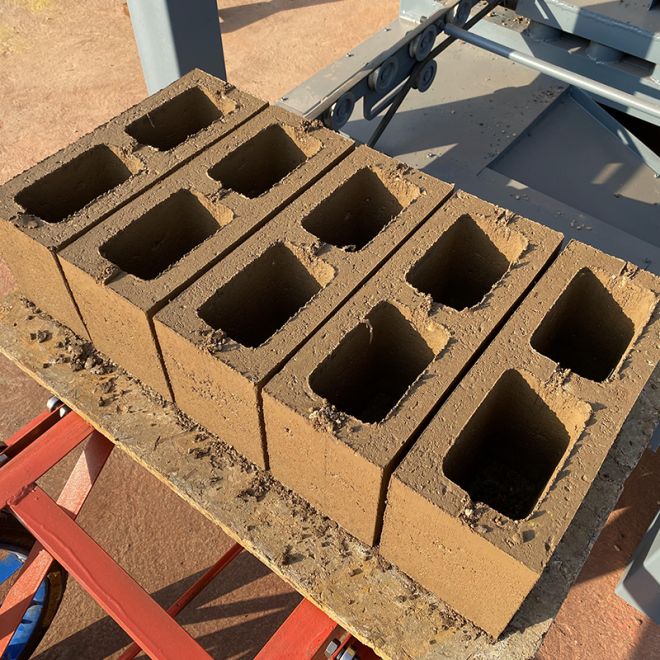
Concrete blocks are mainly used to fill the high-level framework of the building, because of its lightweight, sound insulation, good thermal insulation effect, the majority of users trust and favor. The raw materials are as bellows:
Cement: cement acts as a binding agent, during the block making machine working, it contributes to the strength and durability of concrete blocks, improves workability during production, facilitates setting and hardening, and enhances water resistance. These functions make cement an essential ingredient in the manufacturing of high-quality and reliable concrete blocks.
Sand: sand plays a crucial role in improving workability, cohesion, volume control, shrinkage resistance, and even thermal insulation properties of concrete blocks. Its proper incorporation in the mix ensures the block machine production of high-quality blocks with the desired characteristics for construction applications.
Gravel(crushed stone): gravel contributes to the strength, density, dimensional stability, thermal mass, drainage, permeability, and abrasion resistance of concrete blocks. Its inclusion in the mix ensures the production of robust, durable blocks suitable for various construction purposes.
Fly Ash: It should be noted that the production of concrete blocks, requiring a high strength of the same, it is also required to have low shrinkage values of other properties and so on. Therefore, the fly ash which is more fineness will be better for the products.
Water: It's important to note that while water is essential for concrete block production, the amount of water used must be carefully controlled. The water-to-cement ratio needs to be optimized to ensure proper hydration and achieve the desired strength and durability of the blocks. Excessive water can lead to reduced strength, increased porosity, and potential durability issues, while insufficient water can result in a mix that is difficult to work with and may not fully hydrate.
Raw Material Ratio of Concrete Blocks
Cement: 8-12%
Sand: 30%
Gravel: 58%-62%
Fly Ash: not more than 12%
Water: 7‰
There are many other raw material can produce concrete blocks, such as concrete rubbish, volcanic ash, gypsum, stone powder and so on, you can contact us for more information, we can also help you to build a block factory.


