

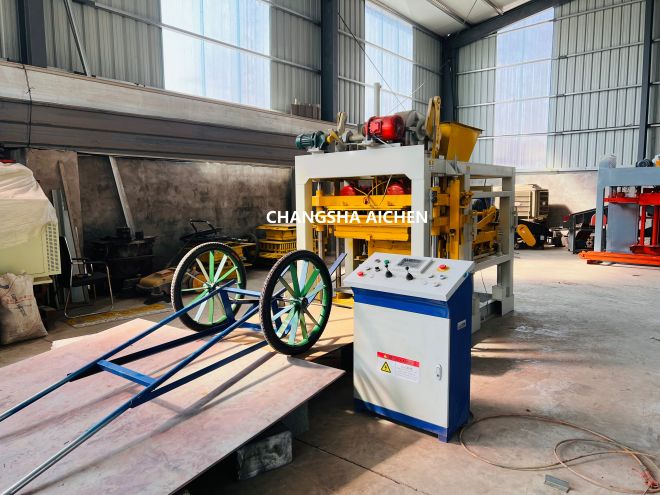
You’re trying to plan QT block investments for 2026, but every forecast seems as clear as wet cement—and somehow everyone’s an “expert” until the numbers don’t stack like your blocks.
To cut the noise, rely on structured market data and long‑term trends, such as those in the IMF World Economic Outlook, then align your QT block production line strategy with demand, costs, and regional growth signals.
1. 📈 Forecasting 2026 demand trends for QT block production lines worldwide
By 2026, global demand for QT block production lines will grow steadily, pushed by urban housing, road upgrades, and sustainable building projects in Asia, Africa, and Latin America.
Manufacturers that offer flexible capacity, low energy use, and easy maintenance will win more orders from public projects and private real estate developers worldwide.
1.1 Residential and social housing projects
Mass housing schemes will keep driving sales of compact QT lines such as the QT4-24 hollow block manual machine concrete block making machine in usa, thanks to low investment and quick payback.
- High demand in Africa and South Asia
- Government-backed low‑cost housing
- Need for simple, durable equipment
1.2 Infrastructure and paving block growth
Road paving, sidewalks, and logistics parks will boost demand for mid‑range QT lines offering strong vibration and fast cycle times.
- More permeable and interlocking pavers
- Higher output for large projects
- Stable quality for long life pavements
1.3 Shift toward semi‑automatic and automatic lines
Rising labor costs and skill shortages will move buyers from basic manual units to semi‑automatic QT production lines by 2026.
| Line type | Share 2024 | Forecast share 2026 |
|---|---|---|
| Manual | 45% | 30% |
| Semi‑automatic | 35% | 40% |
| Automatic | 20% | 30% |
1.4 Price sensitivity and entry‑level upgrades
Price will still matter, but buyers will prefer machines that give flexible block sizes and better density, like the QT4-25B hollow block making equipment hollow block manual machine price.
- Focus on total cost per block
- Energy and cement saving designs
- Quick mold change systems
2. 🧱 Key technological upgrades shaping next-generation QT block manufacturing efficiency
Next‑generation QT lines will cut cement use, power consumption, and downtime while improving block strength, size consistency, and cycle speed through smart control and better vibration systems.
Producers who upgrade now can win 2026 contracts with higher output, stable quality, and cleaner operation that meets stricter environmental rules.
2.1 Advanced vibration and compaction systems
New vibration tables and frequency control motors pack concrete more evenly, raising block density while lowering cement usage and reject rates.
- Variable frequency vibration
- Optimized mold filling paths
- Reduced micro‑cracks and breakage
2.2 Smart PLC control and remote monitoring
Modern QT lines use PLC touch screens with recipe storage, fault alarms, and remote support for faster troubleshooting and shorter training times.
| Feature | Benefit |
|---|---|
| Recipe storage | Fast switch between block types |
| Remote diagnostics | Lower service travel cost |
| Data logging | Better maintenance planning |
2.3 Energy and material optimization
Upgraded drives, motors, and feeding systems help factories save power and use local aggregates, fly ash, and slag without quality loss.
- Inverter‑driven motors
- Optimized mix designs
- Accurate aggregate and cement dosing
2.4 Data analysis: output gains from automation
Simple automation, including batch systems and stacking robots, can more than double hourly production compared with manual setups while stabilizing product quality.
3. 🌍 Regional capacity expansion plans and policy impacts on QT block plants
By 2026, most new QT block capacity will arise where governments fund housing, transport, and green building, often tied to local content policies.
Producers must match plant layouts to regional labor skills, raw materials, and power stability while meeting safety and emission rules.
3.1 Asia-Pacific: large projects and smart cities
China, India, and Southeast Asia lead investments in automated QT lines for smart city, metro, and industrial park construction programs.
- High‑speed, high‑volume plants
- Preference for automatic handling
- Use of fly ash and industrial waste
3.2 Africa and Middle East: fast urbanization
Growing cities and refugee housing needs pull demand toward robust entry‑level lines like the QT4-24 cheap concrete block making machine paving making machine for sale.
| Region | Main demand driver |
|---|---|
| North Africa | Affordable housing |
| Sub‑Saharan Africa | Roads and small contractors |
| GCC | Industrial and logistics hubs |
3.3 Latin America and Eastern Europe: policy-led upgrades
Stricter building codes and local manufacturing incentives encourage upgrades from outdated machines to semi‑automatic QT lines with better safety standards.
- Tax breaks for new equipment
- Higher strength class requirements
- Local sourcing expectations
4. 🏭 Best-practice layout and automation strategies for modern QT block workshops
Efficient QT workshops shorten material paths, avoid bottlenecks, and keep operators safe while delivering continuous output with low waste and downtime.
By 2026, even small plants can adopt modular layouts that grow step by step as orders increase.
4.1 Linear production flow from batching to curing
Arrange batching, mixing, forming, and curing in a straight or U‑shaped line so blocks never backtrack or cross paths.
- Shorter forklift travel
- Clear separation of wet and dry areas
- Easy traffic control
4.2 Smart handling, stacking, and pallet management
Use simple conveyors and stackers to move green and cured blocks, reducing manual lifting and breakage.
| System | Main benefit |
|---|---|
| Green block conveyor | Faster transfer to curing area |
| Automatic stacker | Lower damage rate |
| Pallet return line | Continuous machine feeding |
4.3 Safety, maintenance, and lean practices
Clear walkways, lock‑out procedures, and preventive maintenance plans keep downtime low and help meet customer delivery dates.
- Daily checks on vibration units
- Labeled spare parts storage
- Standard work instructions
5. ⭐ Why Aichen QT block production lines lead in stability and output
Aichen designs QT block lines for stable 24/7 operation, strong frames, and consistent block quality even under rough site conditions and mixed raw materials.
Users gain higher output per worker, easier maintenance, and better support, which lowers the total cost per block.
5.1 Heavy-duty structure and precise molds
Thick steel frames and CNC‑machined molds give long service life and sharp block edges, reducing chipping and on‑site waste.
- Rigid vibration platform
- Wear‑resistant liners
- Accurate mold tolerances
5.2 Flexible configuration for different markets
Aichen offers manual, semi‑automatic, and automatic QT solutions to match local labor, power, and budget conditions.
| Configuration | Typical user |
|---|---|
| Manual | Start‑up and rural plants |
| Semi‑automatic | Growing regional suppliers |
| Automatic | Large industrial producers |
5.3 Global service, training, and spare parts
Overseas engineers, online support, and fast spare parts delivery help Aichen clients keep uptime high and respond quickly to market demand.
- On‑site commissioning
- Operator and maintenance training
- Long‑term parts availability
Conclusion
By 2026, QT block production lines will face rising demand from housing, roads, and green building policies across emerging markets.
Producers that invest early in efficient layouts, smarter controls, and reliable brands like Aichen will achieve lower costs, stable quality, and stronger competitiveness.
Frequently Asked Questions about qt block production line
1. What is a QT block production line?
A QT block production line is a set of machines that mixes concrete, forms blocks with vibration and pressure, then cures and stacks them for building use.
2. How many blocks can a QT line produce per day?
Output depends on model and automation. Small manual lines may produce 4,000–6,000 blocks per 8‑hour shift, while automatic lines can exceed 15,000 blocks.
3. What raw materials are needed?
Typical mixes use cement, sand, crushed stone or gravel, and water. Many plants also add fly ash, slag, or other local industrial by‑products.
4. How do I choose between manual and automatic QT machines?
Consider your budget, labor costs, power stability, and target output. Manual suits small starters; automatic suits high‑volume, long‑term projects.
5. What maintenance does a QT block line require?
Regularly check bolts, lubrication points, vibration motors, hydraulic oil, and mold wear. Clean the machine daily and schedule deeper inspections monthly.


