

The Evolution of Block Molding Technology
● Key Milestones
The block molding industry has seen several key milestones over the years. In 1868, Frear founded the first stationary plant to build concrete blocks on the American continent. Harmon S. Palmer received the first U.S. patent for "Concrete Block Molding Machinery" in 1887, setting the stage for further innovations. These early developments laid the foundation for the modern block molding machines we see today.
● Major Innovations
One of the significant innovations in block molding technology is the introduction of mobile block making machines. These machines offer flexibility and efficiency in block production, making them ideal for various construction projects. Manufacturers have also developed wholesale mobile block making machines and custom mobile block making machines to cater to specific needs, further driving advancements in the industry.
Laying Machines: Hydraulics
● Functionality and Operation
Hydraulic laying machines are wheeled machines that produce concrete blocks and place them on a concrete floor. The mold and piston move through hydraulic cylinders, creating stronger blocks and allowing the manufacturer to use less concrete. These machines are highly efficient and can produce any kind of hollow blocks, solid bricks, and pavers.
● Advantages and Disadvantages
One of the main advantages of hydraulic laying machines is that they eliminate the need for wooden or steel platforms, reducing costs. However, a fairly large concrete slab is required for production, which can be expensive, and the dimensions must align with the production requirements.
Laying Machines: Manuals
● Cost-Effectiveness for Start-Ups
Manual laying machines are manually executed machines that produce blocks at low cost, making them perfect for the start-up of small-scale block manufacturing businesses. These machines are straightforward to operate and can produce any type of block using different molds.
● Operational Mechanism
The blocks are placed on a concrete floor, and the machine is moved by the operator to the next laying. This procedure eliminates the need for block handling platforms and manipulators, simplifying the production process and reducing operational costs.
Stationary Machines: Hydraulics
● Operational Overview
Hydraulic stationary machines produce concrete blocks that are placed on a wooden platform and then moved to the floor by workers. The mold and piston move through hydraulic cylinders, ensuring the production of high-quality blocks.
● Benefits and Challenges
These machines require relatively small space for production, making them suitable for areas with limited space. However, platforms are needed to move the blocks produced, which can be initially expensive and need regular replacement due to daily wear and tear.
Stationary Machines: Manual Systems
● Cost-Effective Production
Manual stationary machines are designed to produce blocks at a low cost, making them ideal for businesses with limited budgets. These machines are simple to operate and maintain, offering a cost-effective solution for block production.
● Quality of Produced Blocks
Using advanced technology, manual stationary machines can produce high-quality blocks. Some models come with vibrators that improve the quality of the blocks, ensuring they meet industry standards and customer expectations.
Automatic Stationary Plants
● High Productivity Features
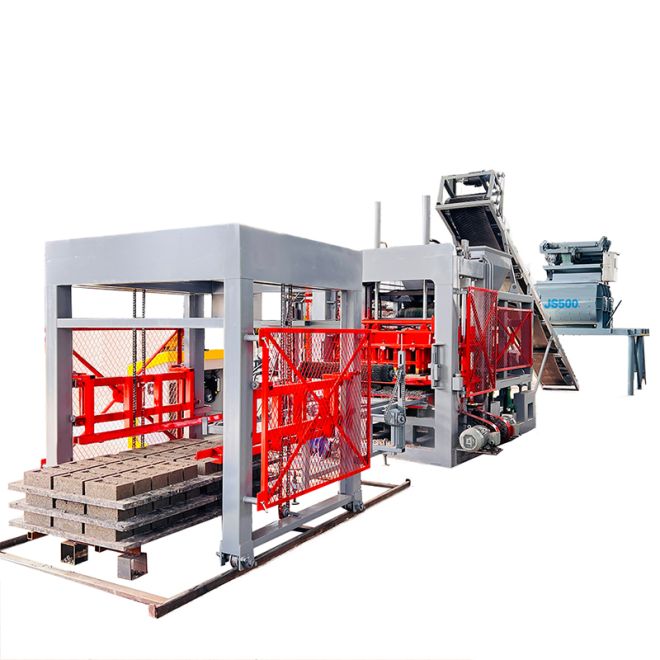
Automatic stationary plants are equipped with batch processing, automated concrete mixing, and pressing systems. These features enable high productivity, with some machines capable of producing 12,000 to 20,000 blocks in an 8-hour shift. The transfer of the blocks is carried out by a transfer system, usually through conveyors, minimizing human effort.
● Minimal Human Effort
One of the standout features of automatic stationary plants is the minimal human effort required. These machines are highly automated, reducing labor costs and enhancing efficiency. However, they are also the most expensive machines, making them suitable for large-scale production settings.
Comparison: Laying vs. Stationary Machines
● Space and Platform Requirements
Laying machines do not require platforms for block transfer, making them ideal for projects with ample space. On the other hand, stationary machines need platforms, which can be expensive and require frequent replacement. However, stationary machines require relatively less space for production.
● Production Efficiency
Both types of machines have their pros and cons in terms of production efficiency. Laying machines are highly efficient for large-scale projects where space is not an issue, while stationary machines are more suitable for smaller spaces but may incur higher operational costs due to platform requirements.
Materials and Resources in Block Molding
● Types of Raw Materials
Various raw materials can be used in block molding, including concrete, cement, and aggregates. These materials are chosen based on the specific requirements of the project, ensuring the production of durable and high-quality blocks.
● Sustainable Practices
The block molding industry is increasingly adopting sustainable practices to reduce its environmental impact. This includes using recyclable materials and energy-efficient machinery. Companies are also investing in research and development to create eco-friendly products that meet industry standards.
Future Trends in Block Molding Equipment
● Technological Advancements
As technology continues to advance, the block molding industry is expected to see further innovations. This includes the development of more efficient and automated machines, as well as the integration of smart technology for better control and monitoring of the production process.
● Market Forecast and Opportunities
The demand for block molding equipment is expected to grow, driven by the increasing need for sustainable and cost-effective building materials. Companies that specialize in mobile block making machines, wholesale mobile block making machines, and custom mobile block making machines are well-positioned to capitalize on this trend.
Conclusion
In conclusion, the block molding industry has come a long way since its inception in the 19th century. Modern equipment, including mobile block making machines, hydraulic and manual laying and stationary machines, and fully automated stationary plants, offer a range of options to suit different production requirements. With ongoing advancements in technology and a focus on sustainability, the future of block molding looks promising.
● Introduction to Aichen
Changsha Aichen is located in Changsha city, Hunan province of China. Since 1999, we have been committed to the research and development, manufacture, and sales of concrete block making machines. Aichen manufactures a wide selection of concrete-product machines and block production lines, ensuring the highest quality standards using the latest global technology. Our products include brick machines, block forming machines, automatic block production lines, and more, all designed to meet diverse construction needs while promoting sustainable practices.


